Showing posts with label lathe. Show all posts

Sunday, May 22, 2016

How to buy a vintage wood lathe

Itching for a new pastime and think woodturning might be your thing but don't want to spend a lot of money on an unproven hobby. So you troll Craigslist but lathes in your price range were hot stuff during the Eisenhower administration. Then you spy this little beauty with some scratches and patina and it calls to you. For the price of date night you could be a woodturner; but should you buy it? What are you getting in to?

1920's-30's Goodell Pratt, not recommended for a first lathe.

Let's narrow this down quickly -- my recommendation is focus your search on cast iron by recognizable brands (Delta, Craftsman, Etc.) lathes that were manufactured after 1945. Why? Over time popular features became standardized making it easier to reuse chucks, centers, faceplates, etc. as you upgrade lathes. Lathes from the 1800's and early 1900's may have oddball or even one-off spindle and thread combinations that will require custom adapters. Machine tapers were not yet standardized and they may have Morse. Prior to about 1940 bearings were likely to be bronze bushings which require frequent oiling and are a poor choice for high speed motors. Ball bearings became common after 1950. There are good choices besides Delta or Craftsman but those two are the most common and both standardized early. Post 1950 should keep you away from oddball stuff; late 50's is even better. In fact, the newer the better but this article is focused on lathes from 1950-1980. Check the bottom of the article for a list of older lathes that are suitable for modern beginners.

What is this talk of standardization? Modern wood lathes have two ways to attach accessories, 1) threaded spindles and 2) machine tapers. The spindle is the shaft to which your work attaches on one end and power attaches on the other end. The case that holds the spindle is called the headstock. Modern lathes have threading on the outside of the spindle so that faceplates or scroll chucks like the Nova G3 can thread on. The spindle is hollow, and the working end will have a machine taper into which accessories like drive centers, drill chucks or drill bits can fit. But lathes didn't always have both threads and tapers, and it's possible for the headstock to have a taper but not the tailstock. If the lathe you are considering doesn't have both a threaded spindle on the headstock and a machine taper on head and tailstock, I would pass on it.

This lathe has a spindle threaded on both ends so you can attach accessories to the outboard side. The silver pin is for indexing.

Lathe with a threaded spindle and Morse taper

Threaded spindles come in several sizes, the three most common in order are 1"-8 tpi (1" spindle with 8 threads per inch), 3/4"-16 tpi, and 1-1/4"-8 tpi. Lathes eventually standardized on Morse taper inside the spindle but very old lathes may have other tapers. Vintage Delta lathes are almost always 1-8 thread and #2 Morse taper in headstock and tailstock. Vintage Craftsman lathes are almost always 3/4-16 threads and #1 Morse taper in headstock and tailstock. There are exceptions, but they are rare.

What about the motor? Most old lathes will come with a 110V motor between 1/4 - 1 HP and will have 4 pulleys on the headstock giving you 4 possible speeds. These are enough for basic turning but eventually you can add variable speed to get much more utility from your lathe.

A "4 speed" lathe, note the step pulley with 4 grooves. Speeds are changed by moving the v-belt. 
Swing is the distance between the center of the spindle and the bed of the lathe, doubled. So if that distance is 4.5", it is a 9" swing lathe. The greater the swing the larger the items you can turn. Craftsman sold bajillions of 9x30 lathes, 9" swing and 30" max capacity between centers. If you want to make table legs, these 9x30 lathes are ideal. They are also useful for other spindle work like tool handles, honey dippers, spoons, cups, and small bowls. Delta lathes are more commonly 12" swing and allow you a little more room for bowls and platters. Delta also sold gap bed lathes, like this 46-111, that have more swing near the headstock.

1958 Craftsman 9x30 bench lathe modified with variable speed
1970's Rockwell Delta 46-111 gap bed lathe


So what to buy? My top recommendation would be a Delta because of the larger spindle and swing. I recommend buying a Delta or Craftsman lathe made in the 50's or later that has a threaded headstock spindle (sizes 1-8 or 3/4-16) and Morse taper in both head and tail stock. Look for a manual on vintagemachinery.org. Sometimes the manual will not tell you the tapers or thread sizes but it will be good information regardless. If the taper size isn't listed anywhere, they are easy to measure. A #1MT (Morse taper) is a little less than 1/2" across on the spindle. A #2MT is a tad over 11/16" diameter on the spindle. Before buying, have the lathe running and listen for any screeching, scratching, or grinding that may indicate bearings need replacement. Make sure the tailstock turns in and out freely and that the centers are removable from both head and tailstock. With centers in place, slide the tailstock to the headstock and check that the center points touch. A tiny amount of misalignment is not a deal killer but a big misalignment may indicate a Frankenlathe (a lathe assembled from parts of other lathes), mismatched parts, or other problems.

A list of vintage lathes that are good candidates for modern use. All lathes listed below have ball bearings or roller bearings, cast iron bed, a #1 or #2 Morse Taper, same taper in the headstock and tailstock, and a common spindle size. Years noted are the oldest I've been able to verify for a particular model, earlier years may not have ball bearings, tapers, or other conveniences. If no year is listed then I believe all years of that model to be the same. I welcome your contributions. Check back for updates.

Format:  Manufacturer | Model | Earliest Year | Size | Bearings | Taper Size | Spindle Size | Notes
How to read the size: a 12x36 lathe will have a swing of 12" (the spindle is 6" from the lathe bed) and 36" between centers.
  • Power King Deluxe (1933+), 11x36, ball bearings, 2MT, 1x8 spindle
  • Power King 7100, 10x37, ball bearings, 1MT, 3/4x16 spindle
  • Power King 7120, 12x37, ball bearings, 2MT, 1x8 spindle

  • Sears Craftsman 103 (1948+), 9x30, ball bearings, 1MT, 3/4x16 spindle
  • Sears Craftsman (1940+), 10x36, ball bearings, 2MT, 1x8 spindle [Was advertised as a 10x54, 54 being the length of the bed. Sears had a long history of exaggerating specs up through the 1980s]

  • Delta 930 (1935 and later), 11x37, Timken roller bearings, 2MT, 1x8 spindle
  • Delta/Rockwell 46-111, 11x36, ball bearings, 2MT, 1x8 spindle
  • Delta 1460 (1940+), 12x37, ball bearings, 2MT, 1x8 spindle
  • Delta 46-305 and variants, 12x37, ball bearings, 2MT, 1x8 spindle
  • Delta 46-400, 12x38, ball bearings, 2MT, 1x8 spindle

  • Powermatic 45, 12x39, ball bearings, 2MT, 1x8 spindle
  • Powermatic 90, 12x38, ball bearings, 2MT, 1-1/2x8 spindle
  • General 160, 12x37, ball bearings, 2MT, 1x8 spindle
  • Montgomery Ward/Duro, 14x38, ball bearings, 2MT, 1-1/8x7 spindle [this is an uncommon spindle size but Teknatool does have it on their list of adapters.]

Thursday, March 17, 2016

Will Home Made Spindle Washers Cause Run Out?

If you've been woodturning for awhile and use scroll chucks then you've probably had a chuck that seized on the threads and is difficult to remove. Grease or oil will not prevent stuck chuck but there are anti-seize compounds based on copper or graphite that can help. Another way is a plastic washer, called a spindle washer, that prevents the chuck from getting super tight. These washers can be purchased commercially or made in the shop.

I tend to pack rat jars and containers for various uses. One day a plastic jar lid caught my eye and I decided to make a spindle washer. After some experimentation I found that larger, thicker, lids like those from peanut butter, peanuts, mayonnaise, etc. made better washers. Pass on any lids with writing or other decoration. My method is simple, drill a 1" hole in the center of the lid (use whatever size matches your spindle), mount it on the lathe held in place with a faceplate or chuck and use a parting tool to remove the outside rim. It doesn't have to be perfect. You can make them any size you want. Most of the time I can remove a chuck using only my hand, occasionally after a long turning session I need a little leverage but the washer still prevents the chuck from seizing up tight.


A common concern is that plastic lids are not made with any precision and will cause excessive run-out which expresses itself as vibration. I decided to test a homemade spindle washer and find out how much runout it introduced.

First I measured a washer using an iGaging digital caliper accurate to 0.001" and with a resolution of 0.0005". Now I don't remember from what kind of lid this washer was made, I've had it for more than a year. But measuring various points around the washer, the deviation was never more than 0.0005" so the total variation is withing 0.001" which I found quite impressive.


Next I chucked the largest Forstner bit I own into my Nova G3 and tested runout using a dial indicator against the shank. The results were surprising. The very first test was after turning a handle for a beater chisel and I did not clean the threads beforehand, consequently it had the greatest runout of any test. Really, that test should be thrown out but I included it. The three remaining tests were done with clean threads.


The runout will be magnified as you move away from the center so if my test piece were 2" in diameter, the measured runout would be approximately doubled. Testing shows the washers introduce some runout but less than what the chuck itself introduces. So claims they introduce wobble are valid, however; the chuck introduces even more wobble so how much is acceptable to you. At the end of the day these are wood lathes and I'm not attempting to make precision parts so for me the washer is an acceptable trade off.

Sunday, November 1, 2015

Refurbishing a Delta Homecraft Lathe Headstock

I recently purchased just the headstock for a Delta Homecraft Lathe. Delta sold different models of lathes with this same or very similar headstock from the early 30's until the mid-50's so I don't know when specifically this headstock was sold.

Before and After


I stripped the headstock down completely, cleaned and looked at every part. The Timken tapered roller bearings (1) & (2) are in excellent condition and did not need replacement. The spindle threads had some minor damage which I repaired with a needle file. 


Unfortunately the indexing pin point was damaged sometime in the past but is still usable. 


Since I was down to bare metal I filed the casting seams fairly smooth


And repainted with Rustoleum Dark Machine Grey.


One little mishap during the process, the badge was damaged. 


Now what to do with it? My original plan was to make a bowl lathe / disc sander. I might still do that or might end up reselling it. 


Saturday, October 17, 2015

Nova G3 vs. Nova Precision Midi lathe chucks

I've been using a Nova Midi chuck but wanted an upgrade. So when I spied an open box G3 on Amazon Warehouse with 2 sets of jaws for $124 shipped, I bit. The G3 was supposed to be direct threaded for 1x8 threads but instead mine was threaded for 1-1/4x8. No problem, I ring Amazon on the blower (opened a chat with customer service) and told them I would keep it if they gave me credit to buy the proper insert. No problem says Amazon and within 2 days my insert had arrived.

G3 (left) and Precision Midi (right)
The Midi was purchased used and came with 2" and 1" jaws, a woodworm screw, allen keys, and tommy bars for around $50; not a bad deal. The G3 also came with 2" and 1" jaws, a woodworm screw, allen keys, and the wrench doohickey; for a little less than $124. My lathe is still not 100% operational so I haven't turned with the G3 yet so this is not a proper review although I don't believe a review is really necessary. [Update: I have used the G3 a good bit and it performs equal to the Midi although I prefer it since I can scroll the jaws one handed.] The G3 is among the most popular lathe chucks sold and Teknatool makes high quality chucks. What I am doing is comparing size and heft of the two chucks since the G3 looks considerably bigger so you'd expect it to be beefier, but is it?

G3 (left) and Precision Midi (right)


So in about every way, the G3 dwarfs the Midi so you'd expect it to be a heavier duty chuck. But as you can see in the pictures above, the G3 is mostly hollow. Placed on the scale, the G3 weighs in at 55 oz., or 1.56 kg.; the Midi weighs 53 oz. or 1.50 kg. The 2 oz. difference is the G3 has a threaded insert, the Midi is direct threaded for 1x8. They are essentially the same weight.

Precision Midi

Nova G3
One advantage the Midi has over the G3, and it's pretty significant to owners of gap bed lathes, is that being shorter it allows more room for turning platters. The G3 is so long it renders the gap on my Delta 46-111 useless. Of course the main advantage of the G3 and why I wanted to upgrade was that you can open or close the jaws one handed while using the other hand to steady the wood blank or bowl. The Midi chuck requires 3 hands unless your lathe comes with a spindle lock. So was the G3 really an upgrade? It's sounding less and less so, but the G3 also has set screws on the spindle threads so it can be reversed. The Midi has no set screws and if you reversed the lathe it would spin itself right off the spindle.

Amazon affiliate links:

Tuesday, September 29, 2015

Rockwell Delta 46-111 Lathe, Part 4: Remote Control Pendent

A long overdue update. The lathe has been repainted, reassembled, the variable speed motor installed, and I've began working on a remote control pendant like those found on Robust or Vicmarc lathes.

current status of the remote


Treadmill motors have a soft start feature so the treadmill must always start at the slowest possible speed, a good safety feature in a treadmill but not desirable in a lathe. Reportedly you can bypass the softstart feature on an mc-60 controller (most common type) by switching the wiper on the potentiometer. Unfortunately I am not using an mc-60 controller and switching any of the potentiometer wires individually does not stop the motor. As time goes on I will experiment with switching multiple wires at once and report back. As it sits now, the speed control works just fine but the little on/off switch does diddly squat. There is a main power switch on the lathe stand for cutting power to everything.

GE PWM speed controller

Dell powerbrick repurposed as a remote control

Switching the center wire to stop/start the motor, an idea that did not work.


Non functioning power toggle and perfectly functioning potentiometer.


Friday, May 1, 2015

Rockwell Delta 46-111 Lathe, Part 3: Variable Speed

This will be my 2nd lathe converted to variable speed.
[edit; for some reason Blogger deleted the photos so I have edited this blog with updated info and pics.]

This is the lathe, a Rockwell 46-111, circa 1974. Which I have finished repainting. You can read more about the lathe in previous blog posts.


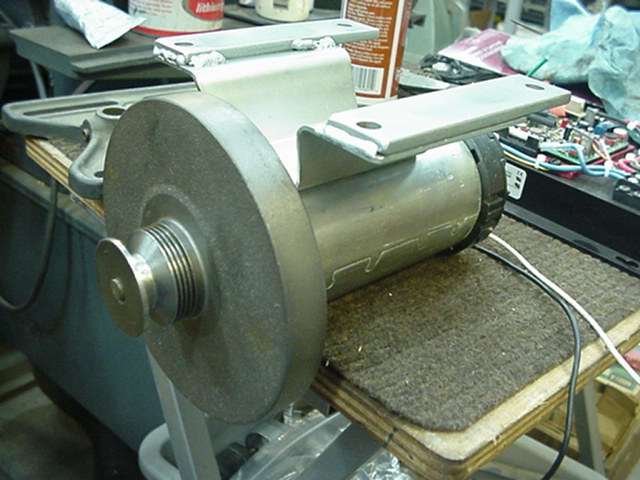
This is the motor: 1hp at 90 VDC. Big improvement over the 1/2hp original motor. It's from a popular brand of treadmill. Originally it had a digital control panel and extra boards but I eliminated all that and attached a 5k linear taper potentiometer from Radio Shack. The treadmill cost me $30. I listed the control panel on ebay and it sold within hours for $35, plus $25 for the scrap metal and I came out ahead.


Two things left to do.
[edit; I switched to a motor with a V pulley so everything from here down was unnecessary.]
  1. Make a new motor mount or modify the original. Shouldn't be difficult.
  2. The DC motor has a flat pulley but the lathe has V pulleys.


The most common solution is removing the flywheel and attaching a V pulley. I could do that but then I lose the torque benefit of the flywheel and extra torque is always welcome on a lathe. 

This chap had a great solution. Unfortunately I do not have a metal lathe and at 1-1/8" dia the flat pulley on mine is too small to accommodate a V belt. 


So I'm thinking I will make a 2nd pulley that will slide over the flat pulley. A 2" pulley would put me in the range of 3500 RPM at the spindle. I'll soon let you know how well it works.

Wednesday, April 29, 2015

Rockwell Delta 46-111 Lathe, Part 2: Paint

Indexing pin and tail stock levers that originally were bare metal but I painted them black to protect against rust and improve appearance.
Anything I could fit in a toaster oven was baked at approximately 150 degrees Fahrenheit for two hours. Not sure of the exact temperature but you could touch the parts with only mild discomfort. The paint instructions said not to exceed 190 degrees.

Freshly repainted tool rest and banjo. The color darkens when dry.

Repainted bed. Same color as tool rest but the paint has dried for a few days, and shop lighting is less intense.
Better than a new dog. That logo pops!
Tail stock back together with nice new paint, looks better than 1974.

Next steps are reassembly and conversion to variable speed.


Sunday, April 26, 2015

Goodell Pratt bench lathe, Part 4: reproduction knob

My first try at a reproducing the missing tool rest knob. I goofed and made the diameter a bit too small but otherwise it looks pretty good. I'll make another but this was good for getting for the dimensions and general shape. We'll call it proof of concept.


I started by gluing up scraps of maple and beech. Beech is on the outside right.


I always forget to take pictures but I measured the original with calipers, transferred that measurement to the wood blank using the same calipers and a parting tool, then blended the curves.


Before cutting to final size, I drilled a 3/8" hole through the center and installed a 1/4-20 threaded insert. I also marked off 12 equal divisions around the perimeter using the indexing wheel of my lathe then ground 12 grooves using a Dremel. I didn't bother sanding out the burn marks because this will be painted black eventually.


After friction polish (shellac/oil). Not shown here but I also seated the threaded insert a little deeper.


Comparison with original:


Friday, April 24, 2015

Rockwell Delta 46-111 Lathe, Part 1: Overview


Picked up a 1974 Rockwell Delta 46-111 wood lathe. This was a light duty lathe sold by Delta for over three decades, from the 50's - 80's. It is a "gap bed" lathe. The theory being you can turn a larger piece near the head stock but the gap is so short that it would only be useful for turning plates or platters. Besides a little surface rust, the lathe is in excellent condition and included the original 1/2 hp motor and sheet metal stand.


Specs:


  • 11"/14" swing
  • 36" between centers
  • 1"-8 spindle threads
  • #2 Morse tapers
  • 4 speeds (990, 1475, 2220, 3250)

In the late 60's or early 70's, Rockwell wanted to reduce cost so did away with the cast iron stand in favor of sheet metal which rattles like a meth head on a thunder machine if not braced and fastened to the floor. They also changed the tailstock from cast iron to cast aluminum. At least they upgraded it to a fast lever locking system instead needing a wrench.


The 46-111 indexing wheel has two rows. An inner row with 60 holes and an outer row with 8 holes. The manual includes a chart to tell you the #holes for common divisions.

Next step will be a good scrubbing, repainting, reassembly, then converting to variable speed.