Showing posts with label variable speed motor. Show all posts

Tuesday, September 29, 2015

Rockwell Delta 46-111 Lathe, Part 4: Remote Control Pendent

A long overdue update. The lathe has been repainted, reassembled, the variable speed motor installed, and I've began working on a remote control pendant like those found on Robust or Vicmarc lathes.

current status of the remote


Treadmill motors have a soft start feature so the treadmill must always start at the slowest possible speed, a good safety feature in a treadmill but not desirable in a lathe. Reportedly you can bypass the softstart feature on an mc-60 controller (most common type) by switching the wiper on the potentiometer. Unfortunately I am not using an mc-60 controller and switching any of the potentiometer wires individually does not stop the motor. As time goes on I will experiment with switching multiple wires at once and report back. As it sits now, the speed control works just fine but the little on/off switch does diddly squat. There is a main power switch on the lathe stand for cutting power to everything.

GE PWM speed controller

Dell powerbrick repurposed as a remote control

Switching the center wire to stop/start the motor, an idea that did not work.


Non functioning power toggle and perfectly functioning potentiometer.


Friday, May 1, 2015

Rockwell Delta 46-111 Lathe, Part 3: Variable Speed

This will be my 2nd lathe converted to variable speed.
[edit; for some reason Blogger deleted the photos so I have edited this blog with updated info and pics.]

This is the lathe, a Rockwell 46-111, circa 1974. Which I have finished repainting. You can read more about the lathe in previous blog posts.


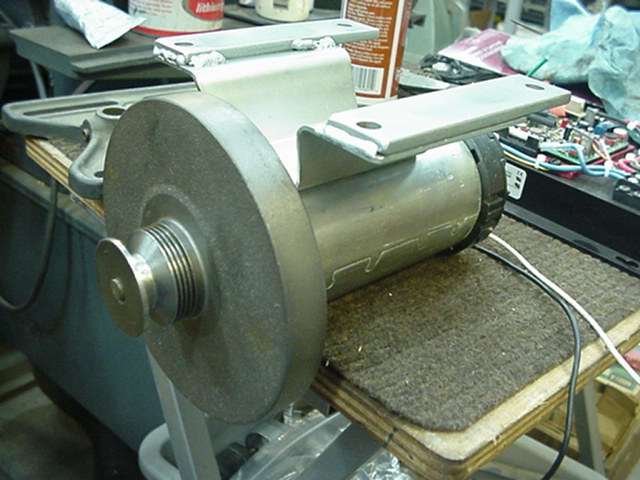
This is the motor: 1hp at 90 VDC. Big improvement over the 1/2hp original motor. It's from a popular brand of treadmill. Originally it had a digital control panel and extra boards but I eliminated all that and attached a 5k linear taper potentiometer from Radio Shack. The treadmill cost me $30. I listed the control panel on ebay and it sold within hours for $35, plus $25 for the scrap metal and I came out ahead.


Two things left to do.
[edit; I switched to a motor with a V pulley so everything from here down was unnecessary.]
  1. Make a new motor mount or modify the original. Shouldn't be difficult.
  2. The DC motor has a flat pulley but the lathe has V pulleys.


The most common solution is removing the flywheel and attaching a V pulley. I could do that but then I lose the torque benefit of the flywheel and extra torque is always welcome on a lathe. 

This chap had a great solution. Unfortunately I do not have a metal lathe and at 1-1/8" dia the flat pulley on mine is too small to accommodate a V belt. 


So I'm thinking I will make a 2nd pulley that will slide over the flat pulley. A 2" pulley would put me in the range of 3500 RPM at the spindle. I'll soon let you know how well it works.

Tuesday, January 20, 2015

How to wire an HVAC fan motor for 3 speeds

Disclaimer, I am not an electrician or in any way qualified to give electric advice. Following my instructions may result in a fantastically painful death and/or total loss of property and innocence,  but probably not. 

It's man's nature that if you have a motor capable of three speeds you will want to use all of them. Such was the case when I was looking for a motor for a small shop project. My choices were between a 1/4 HP single speed motor or a 1/4 HP three speed HVAC fan motor. The fan motor was designed so that you pick one speed, wire it, and that would be your speed forever. But does it have to be that way?

Probably not but then I had to figure out how to wire it. Simple, I found a rotary switch on Grainger: off/on/on/on. Not simple, I was advised by the internet this switch would cause my untimely death or at best, burn out in short order. OR, it was perfectly okay and would only last 100,000 cycles instead of 200,000. Back and forth came the advice with lots of technical mumbo jumbo about snapping that was over my head. I had 3 people telling me it was a bad idea and 3 telling me it was fine. And all of them seemed credible. One fellow had an engineering background and had worked for a switch manufacturer so I gave his advice more credence. The only thing all 6 could agree on was that toggle switches would be safer. So I called Grainger, ’We don’t sell switches rated for ac motors. Don’t use any of our switches!’ You think I’m kidding but that’s almost word for word what they told me. It’s also a bald face lie, they do sell switches rated for ac motors. So I threw in the towel and bought toggles rated for AC motors from Home Depot. They had no problem with me buying their switches and even walked me directly to them in a rare display of eptitude. In the end, of the 6 people actively giving me advice, only one was happy I went with toggles, the other 5 were disappointed in the lack of apocalyptic outcomes.


So you want to know how to wire a 3 speed HVAC direct drive AC motor? Here’s how I did it.

1 each – SPST (on/off) Gardner Bender toggle switch
2 each – SPDT (on/off/on) Gardner Bender toggle switch
wire, motor, and appropriate electrical housing w/ cover


Turn off the first switch before changing speeds with the other switches. If you know of a more elegant way, feel free to post it in the comments below. If you believe my way will be my doom, well I'm here writing about aren't I?

Update: for clarity: Green = ground, white = common, black = high, blue = medium, red = low. If you have more colors I don't know what they do.

Sunday, November 23, 2014

Variable speed lathe using a DC treadmill motor

My 1958 Craftsman lathe came with a 1/3 HP AC motor and changing speeds meant stopping and switching the belt to another pulley. Blech! A little research yielded a cheap solution -- a treadmill motor. Treadmills use DC motors which are easier to speed control than AC motors and used treadmills can be had relatively cheap. Components to the system are the DC motor, motor controller (PWM), potentiometer (pot), switch, fuse, and usually a choke (transformer).

Wiring is simple as seen in this schematic.


The motor controller converts AC power to DC, the choke smooths the power and gives the motor better performance. The potentiometer is an ordinary linear taper from Radio Shack. The most common controller is the MC-60. I believe all controllers are adjustable for high and low speed but I found no need, the default settings were fine.


Control panel that houses the controller, switch, and pot.
The switch plate is a bit garish but fun.

I designed a speed chart to go around the potentiometer. To see how I determined speeds, see my post on a shop made strobe tachometer.


Pictures of my DC motors and controllers.

1 HP DC motor
motor controller
Back of potentiometer 
MC-60 controller

1.5/2.5 HP DC motor
Your motor should come with a heavy flywheel to improve torque.

And on the lathes. First pic has messy wiring, later I made it tidy.


Same motor on my Goodell Pratt lathe.