Showing posts with label books. Show all posts
Showing posts with label books. Show all posts
Friday, May 25, 2018
Book Review: Mid-Century Modern Furniture: Shop Drawings & Techniques for Making 29 Projects by Michael Crow


Wednesday, January 11, 2017
Building the Perfect Tool Chest by Jim Stack [book review]
Building the Perfect Tool Chest by Jim Stack
 Let me start by saying I love this book. I first found it in our
 local library and after renewing it three times decided to own it. In a nutshell it is fifteen tool box plans. Not the fancy shmancy quilted mahogany with ivory inlay type of boxes, or the kind where the tools are stacked eight levels deep, or the faddish type that are all the rage in magazines, but the kind of tool holders that most of us would use day to day.
There is considerable variety from a simple box with lid, large tool chests, open tool tote, chest of drawers, a hanging cabinet, and even a box for fisherman. For each tool box there is a detailed materials list in both inches and metric, lots of photos and illustrations, and helpful tips on joinery and assembly. Many of the boxes are built with plywood or pine but you can substitute any material. Joinery varies a bit from box to box.
There are fifteen projects and fifteen sections or chapters, plus a short introduction, a list of suppliers, and an index. This book assumes you have the basic knowledge and skills to complete the projects. It is not teaching woodworking, it is sharing ideas. So many times I've been disappointed because the cover has a couple nice projects but half the book is how to use a screwdriver and where to buy router bits. This book is fluff free and in my opinion all the toolboxes look useful and are logically constructed.
If you wish to buy Building the Perfect Tool Chest, you can click the cover picture above to find it on Amazon.
Table of Contents

Tuesday, November 25, 2014
Woodwork Visualized: shop class in a book. [book review]

[TLDR version: fledgling woodworkers should get a copy of this book or read it online for free.]
Ever wanted to predict which way a stick of lumber will warp? Curious why heartwood is more stable than sapwood? Cramlet crams much useful information about how trees grow, why and how lumber warps, how timber is cut into boards, how to measure board feet, and tips on selecting the strongest wood for handles (use fast grown, straight grain, wood); all in just four pages packed with pictures.
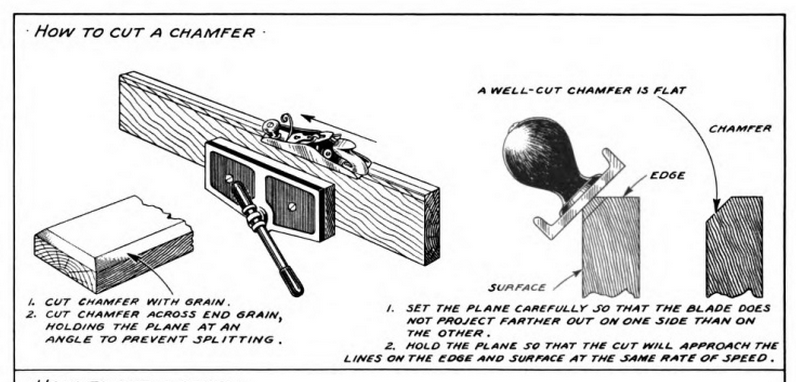
- How to lay out common shapes with a compass.
- Transferring designs with graph paper.
- Setting up, tuning, and using hand planes.
- Basic chisel cuts.
- Filing. Rasping. Shaping. Sawing.
- Several sections on wood joinery, marking, cutting, and fastening.
- Sharpening. You know we woodworkers like to obsess about that.
- And basic finishing.

There are a few projects at the end. Beginning with a simple box and working up to a saw bench, wall cabinet, workbench, tool box, and basic furniture. Projects may vary by edition.
Subscribe to:
Posts (Atom)