My first try at a reproducing the missing tool rest knob. I goofed and made the diameter a bit too small but otherwise it looks pretty good. I'll make another but this was good for getting for the dimensions and general shape. We'll call it proof of concept.
I started by gluing up scraps of maple and beech. Beech is on the outside right.
I always forget to take pictures but I measured the original with calipers, transferred that measurement to the wood blank using the same calipers and a parting tool, then blended the curves.
Before cutting to final size, I drilled a 3/8" hole through the center and installed a 1/4-20 threaded insert. I also marked off 12 equal divisions around the perimeter using the indexing wheel of my lathe then ground 12 grooves using a Dremel. I didn't bother sanding out the burn marks because this will be painted black eventually.
After friction polish (shellac/oil). Not shown here but I also seated the threaded insert a little deeper.
Comparison with original:
Showing posts with label Goodell Pratt. Show all posts
Sunday, April 26, 2015
Wednesday, April 22, 2015
Goodell Pratt bench lathe, Part 3 of restoration project
The GP is painted and back together. The bare metal is waxed only, not shined and polished, something that may or may not be done. The vermilion/paprika color defies my phone camera so these pics are not exactly the right shade.
I have more plans for this lathe which I will cover in a future blog. It won't be restoration exactly, more reproduction work. Also considering a video of taking this apart and showing the inner workings, not much to show but might be interesting to a few. Let me know if you would like to see that in a video. Might be a couple weeks before another update as I have finished painting another machine and need to reassemble it.
![]() |
| Best representative of the vermilion color. |
Saturday, April 18, 2015
Goodell Pratt bench lathe, Part 2 - Painting
Vermilion Red
Goodell Pratt's trademark colors were black and vermilion red, which is an orange red. The closest I could find was Paprika by Rustoleum. It's not quite right but short of having a custom color mixed, it will do. And even if I wanted a custom color mixed, I have no perfect sample to match. The color on my lathe and grinder are not a perfect match, and I don't trust pictures on the internet. Speaking of pictures on the internet, if you Google "Rustoleum paprika", the color is more reddish. That's because I bought the wrong color. Someone had switched caps, putting a paprika lid on a can of orange paint and I didn't catch it until after I started spraying.
![]() |
| In the oven |
UPDATE:
Went back to the store and bought the right color paint. Pic below.
![]() |
| Paprika |
Here is [actual] Rustoleum Paprika.
My GP grinder with factory paint.
Other GP color samples from the internet.
Colors are all over the place.
Black
This one is easy although a purist may dislike the semi-gloss finish since GP had a particular gloss level. I don't know what that gloss level was, but the internet is sure there was a specific one.
The Paint
I used Rustoleum Painter's Touch Ultra 2X. Supposed to be a paint and primer all in one that provides better coverage than their regular spray paint. Their Professional series covers the best if you ask me but this isn't bad.
Friday, April 17, 2015
Goodell Pratt bench lathe, Part 1 of restoration project
A little over two years ago I bought a model 125 GP bench lathe at auction for 2 1/2 sawbucks. It is missing the original tool rest and a few other accessories and had been painted a very Christmas-y green and red.
The lathe is cast iron with milled ways. Like all things Goodell Pratt it is sturdy and built to last the ages. Model 494 was the bigger brother and was six inches longer between centers with the same swing. GP also sold a model 700 model/watch maker's lathe with a 5 inch swing and 3 1/2 inches between centers.
Another feature of early lathes was that of being a multipurpose machine. GP sold a nice array of accessories: A disc sander. An outboard buffing spindle. A fret saw. And a circular saw (table saw). Not to mention an impressive variety of metalworking accessories.
So while it may have limited usefulness as a modern lathe, the 125 and its' brothers exude charm and hearken to a time when design wasn't optimized for an assembly line or retail shelf space.
The headstock uses a cone bearing to account for wear and has two oil ports. These are from a time before electricity was common in rural areas so there is three step pulley for the optional treadle base.
![]() |
| After a cleaning |
The lathe is cast iron with milled ways. Like all things Goodell Pratt it is sturdy and built to last the ages. Model 494 was the bigger brother and was six inches longer between centers with the same swing. GP also sold a model 700 model/watch maker's lathe with a 5 inch swing and 3 1/2 inches between centers.
Model 125 Specs:
- Swing: 7 inches
- 12 inches between centers
- 1 Morse taper headstock with 1x12 threads
- 0 Morse taper tailstock
- Pulley diameters: 1 1/2, 2 1/2, 3 1/3 inches
- Overall length 25 inches
- Height 11 1/2 inches
- Weight 30 pounds
Is/Was this a good beginner lathe?
I am a product of the late 20th Century, it is impossible for me to judge the 125 fully in the context of the early 20th Century when manufacturers were still experimenting. Nowadays, 1x8 headstock threads and 2MT are expected in lathes up to medium size. The 125 is a light duty hobbyist lathe but still the 0MT tailstock taper doesn't make sense. Two tapers means duplicate accessories and the 0MT is just dinky. A 1MT on both ends would have made accessories like the drill chuck more versatile. The 7 inch swing limits use as a wood lathe and I suspect these were more commonly used as metal lathes for which they had a good variety of accessories. I found it difficult to power from a motor without considerable vibration. The height allows too much leverage if the motor is behind the lathe, and the base gets in the way if you try to mount a motor below. The design is really optimized for powering from a large treadle flywheel or from an overhead line shaft. So as a modern day beginner lathe, it misses the mark by a mile. But in context of the late 19th - early 20th Centuries, none of these things were uncommon. Consider the Millers Falls treadle lathe with it's tiny 2 1/2 inch swing, 16 inches between centers and similar design. The popular Barnes No. 4 1/2 with you guessed it -- 4 1/2 inches of swing. Early Oliver treadle lathes had 8 inches of swing, now common 1x8 spindle threads, but non-standard tapers. Styling and design is pre-Art Deco which was about to sweep the world when Goodell Pratt was purchased by Millers Falls and stopped production of this lathe.Another feature of early lathes was that of being a multipurpose machine. GP sold a nice array of accessories: A disc sander. An outboard buffing spindle. A fret saw. And a circular saw (table saw). Not to mention an impressive variety of metalworking accessories.
So while it may have limited usefulness as a modern lathe, the 125 and its' brothers exude charm and hearken to a time when design wasn't optimized for an assembly line or retail shelf space.
Some close ups.
![]() |
| Headstock with three step pulley and oiling ports. |
![]() |
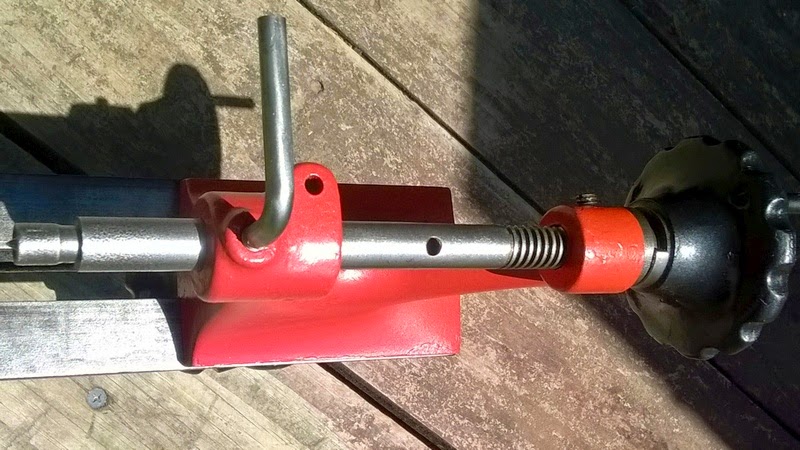
| Tailstock. Missing fast action lever for drilling. |
![]() |
| Tailstock business end sporting a cup center with it's tiny 0MT taper. |
![]() |
| Stand built for the lathe |
Part 2 will be repainting the no. 125.
Friday, November 7, 2014
T-Shirt for vintage tool collectors
Printing is how I earn a buck and last year I made this shirt to wear during the Midwest Tool Collectors Association meeting in North Carolina. It's a two color print, red & white obviously. The front logo comes from an early 20th century Goodell Pratt advertisement. The back print was inspired by the brass badge on my GP model 125 bench lathe. The sleeve print will be familiar to GP fans, that's Mr. Punch promoting the company's automatic drill. I love the slogan, "1500 Good Tools." No company today would abide such an honest statement. While GP never necessarily made "fine" tools, they were heavy duty, and dependable. Eventually Goodell Pratt was gobbled up by Millers Falls but 85 years later they are still "good tools."
I have more vintage tool designs in the works.
Tuesday, October 21, 2014
Goodell Pratt model 485 grinder
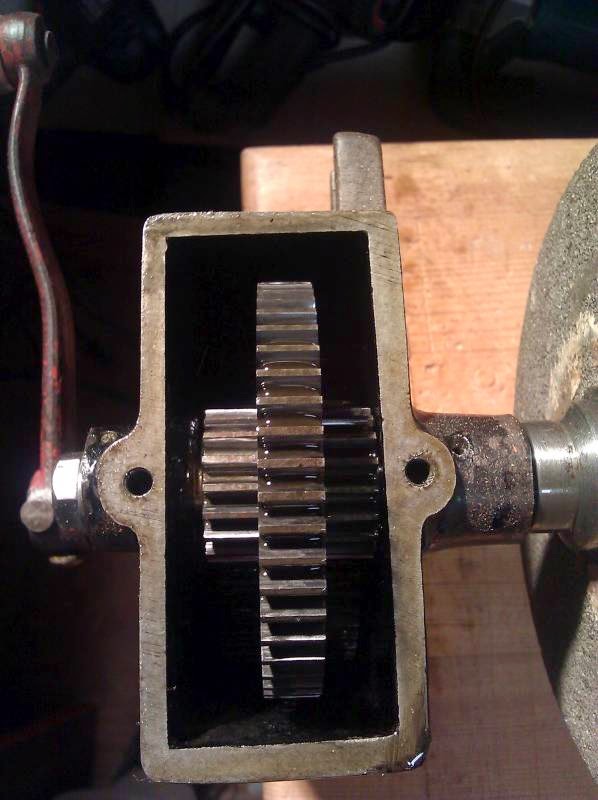
Compared to most crank grinders, the 485 is massive at 11 lbs. but was the baby in the Goodell Pratt family of grinders. The 22:1 gear ratio spins the the wheel at over 1300 RPM with a leisurely 1 crank per second. The gears are beefy and run smooth. This is a high quality crank grinder, as good as you will find.![]() |
| The cleaning took it's toll on the badge, should have covered it with tape. |
Subscribe to:
Posts (Atom)