Showing posts with label Delta. Show all posts

Sunday, November 1, 2015

Refurbishing a Delta Homecraft Lathe Headstock

I recently purchased just the headstock for a Delta Homecraft Lathe. Delta sold different models of lathes with this same or very similar headstock from the early 30's until the mid-50's so I don't know when specifically this headstock was sold.

Before and After


I stripped the headstock down completely, cleaned and looked at every part. The Timken tapered roller bearings (1) & (2) are in excellent condition and did not need replacement. The spindle threads had some minor damage which I repaired with a needle file. 


Unfortunately the indexing pin point was damaged sometime in the past but is still usable. 


Since I was down to bare metal I filed the casting seams fairly smooth


And repainted with Rustoleum Dark Machine Grey.


One little mishap during the process, the badge was damaged. 


Now what to do with it? My original plan was to make a bowl lathe / disc sander. I might still do that or might end up reselling it. 


Tuesday, September 29, 2015

Rockwell Delta 46-111 Lathe, Part 4: Remote Control Pendent

A long overdue update. The lathe has been repainted, reassembled, the variable speed motor installed, and I've began working on a remote control pendant like those found on Robust or Vicmarc lathes.

current status of the remote


Treadmill motors have a soft start feature so the treadmill must always start at the slowest possible speed, a good safety feature in a treadmill but not desirable in a lathe. Reportedly you can bypass the softstart feature on an mc-60 controller (most common type) by switching the wiper on the potentiometer. Unfortunately I am not using an mc-60 controller and switching any of the potentiometer wires individually does not stop the motor. As time goes on I will experiment with switching multiple wires at once and report back. As it sits now, the speed control works just fine but the little on/off switch does diddly squat. There is a main power switch on the lathe stand for cutting power to everything.

GE PWM speed controller

Dell powerbrick repurposed as a remote control

Switching the center wire to stop/start the motor, an idea that did not work.


Non functioning power toggle and perfectly functioning potentiometer.


Friday, May 1, 2015

Rockwell Delta 46-111 Lathe, Part 3: Variable Speed

This will be my 2nd lathe converted to variable speed.
[edit; for some reason Blogger deleted the photos so I have edited this blog with updated info and pics.]

This is the lathe, a Rockwell 46-111, circa 1974. Which I have finished repainting. You can read more about the lathe in previous blog posts.


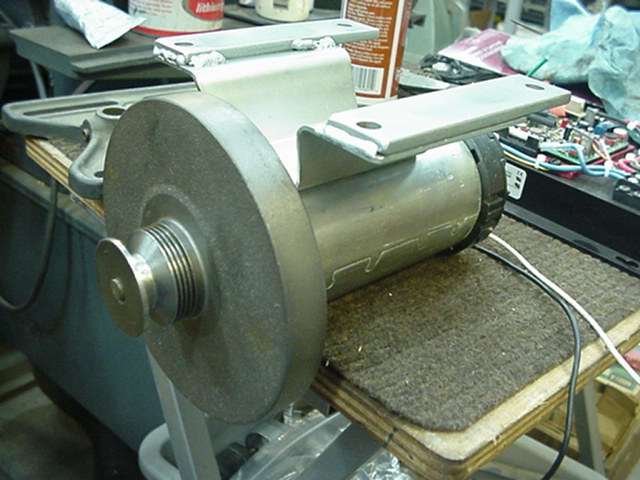
This is the motor: 1hp at 90 VDC. Big improvement over the 1/2hp original motor. It's from a popular brand of treadmill. Originally it had a digital control panel and extra boards but I eliminated all that and attached a 5k linear taper potentiometer from Radio Shack. The treadmill cost me $30. I listed the control panel on ebay and it sold within hours for $35, plus $25 for the scrap metal and I came out ahead.


Two things left to do.
[edit; I switched to a motor with a V pulley so everything from here down was unnecessary.]
  1. Make a new motor mount or modify the original. Shouldn't be difficult.
  2. The DC motor has a flat pulley but the lathe has V pulleys.


The most common solution is removing the flywheel and attaching a V pulley. I could do that but then I lose the torque benefit of the flywheel and extra torque is always welcome on a lathe. 

This chap had a great solution. Unfortunately I do not have a metal lathe and at 1-1/8" dia the flat pulley on mine is too small to accommodate a V belt. 


So I'm thinking I will make a 2nd pulley that will slide over the flat pulley. A 2" pulley would put me in the range of 3500 RPM at the spindle. I'll soon let you know how well it works.

Wednesday, April 29, 2015

Rockwell Delta 46-111 Lathe, Part 2: Paint

Indexing pin and tail stock levers that originally were bare metal but I painted them black to protect against rust and improve appearance.
Anything I could fit in a toaster oven was baked at approximately 150 degrees Fahrenheit for two hours. Not sure of the exact temperature but you could touch the parts with only mild discomfort. The paint instructions said not to exceed 190 degrees.

Freshly repainted tool rest and banjo. The color darkens when dry.

Repainted bed. Same color as tool rest but the paint has dried for a few days, and shop lighting is less intense.
Better than a new dog. That logo pops!
Tail stock back together with nice new paint, looks better than 1974.

Next steps are reassembly and conversion to variable speed.


Friday, April 24, 2015

Rockwell Delta 46-111 Lathe, Part 1: Overview


Picked up a 1974 Rockwell Delta 46-111 wood lathe. This was a light duty lathe sold by Delta for over three decades, from the 50's - 80's. It is a "gap bed" lathe. The theory being you can turn a larger piece near the head stock but the gap is so short that it would only be useful for turning plates or platters. Besides a little surface rust, the lathe is in excellent condition and included the original 1/2 hp motor and sheet metal stand.


Specs:


  • 11"/14" swing
  • 36" between centers
  • 1"-8 spindle threads
  • #2 Morse tapers
  • 4 speeds (990, 1475, 2220, 3250)

In the late 60's or early 70's, Rockwell wanted to reduce cost so did away with the cast iron stand in favor of sheet metal which rattles like a meth head on a thunder machine if not braced and fastened to the floor. They also changed the tailstock from cast iron to cast aluminum. At least they upgraded it to a fast lever locking system instead needing a wrench.


The 46-111 indexing wheel has two rows. An inner row with 60 holes and an outer row with 8 holes. The manual includes a chart to tell you the #holes for common divisions.

Next step will be a good scrubbing, repainting, reassembly, then converting to variable speed.